EN




An EDM drilling machine may provide a useful route for holes in conductive tool and mold components when a mechanical drill is difficult to apply. Select the route from the hole's function, access, material condition and acceptance requirements, not from a general promise of superior accuracy.
A Wire EDM start hole, a finished guide hole and a coolant passage have different jobs. Establish which feature is being made, its machining allowance and the operations that follow. Successful hole formation alone does not establish mold performance or suitability for a regulated component.
Fundamental Principles of EDM Drilling Technology
Electrical Discharge Mechanism
Electrical discharges remove conductive material through localized thermal action across a working gap. Melting and possible vaporization replace conventional chip cutting; they do not make the process non-thermal or stress-free.
Working fluid supports the discharge process and debris removal. Resolidified material and thermal alteration can remain at the wall. Define any recast-layer, crack or surface-integrity acceptance separately from hole dimensions.
Electrode Design and Selection
Rotating tubular electrodes are common in small-hole EDM drilling. Copper or brass tubes may be appropriate, with internal passages supporting fluid delivery. Select the material, tube construction, guide and usable length for the specified machine and hole.
Do not transfer a graphite recommendation for die-sinking cavities directly to tubular hole drilling. Electrode families serve different processes. Confirm consumption, guide compatibility and replacement steps; an automatic changer must not be assumed from the EDM label.
Applications in Tool Manufacturing
Separate Start Holes from Finished Tool Holes
For a closed Wire EDM profile, the start hole provides a threading path rather than the finished profile surface. Its position and clearance must suit the subsequent wire operation, workpiece thickness and clamping arrangement.
For coolant entries or other functional tool holes, review the accessible drilling segment and the remaining manufacturing route. Do not infer a minimum finished diameter, a continuous curved passage or improved cutting-tool life from the ability to make a hole.
Progressive Die Manufacturing
Stripper plates, die inserts and guide-related features need their own drawing review. Separate a preparatory hole from a finished pin seat or locating feature. Leave any required finishing allowance and retain the specified positional and surface acceptance checks.
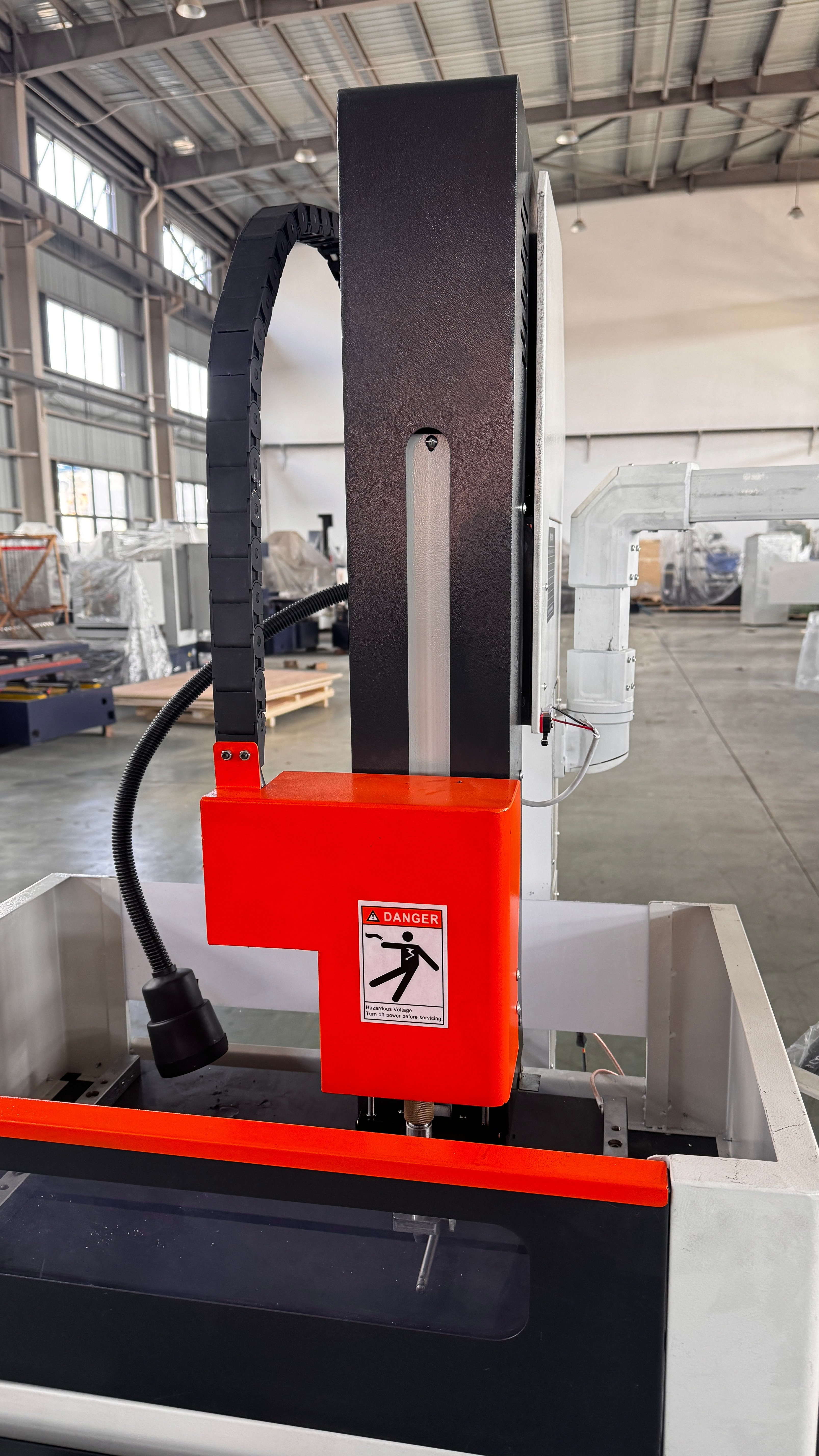
The EDM drilling machine linked here is the D703 non-CNC configuration with controlled Z-axis feed. Hole-pattern positioning and setup remain separate considerations. That feed function does not establish automatic coordinate sequencing, improved die life or freedom from thermal surface changes.
Plan Mold Holes Around Access and Function
Injection Mold Cooling Systems
A conventional straight-electrode drilling arrangement should not be described as a method for arbitrary conformal cooling channels. Establish the accessible straight segments before selecting the manufacturing process.
Angled entries, intersections and breakthrough near another wall require a drawing-specific plan. Access, supported motion and any required protection or finishing must be established for the proposed equipment.
Deep Hole Drilling Conditions
For a deep passage or ejector-related hole, specify diameter, depth, wall thickness and entry and exit conditions together. Guide access, unsupported electrode length, alignment and debris evacuation can limit the practical route; one depth ratio is not a capability guarantee.
Reduced conventional cutting force does not eliminate electrode deflection, runout or hole deviation. Check the required centerline and accessible entry and exit features using an agreed method. Review how deeper regions will be assessed when their condition matters.
Review the Actual Workpiece Material
Conductive Hardened Steels and Alloys
Identify the alloy grade, heat-treatment condition and any coating before planning a tooling hole. Conductivity is necessary for standard EDM, but hardness alone does not predict cycle time, electrode consumption or the finished surface.
For an alloy mold insert, agree whether drilling occurs before or after heat treatment and which surfaces must remain unchanged. Assess the actual sequence and acceptance requirements instead of assuming that EDM preserves every material property or creates inaccessible internal passages.
Ceramic and Composite Suitability
The names ceramic and composite do not establish EDM suitability. Review the specific grade, conductive path, reinforcement and binder, together with the feature geometry. Do not assume that a conductive constituent makes the entire workpiece uniformly machinable.
A trial should examine relevant edges and hole walls for the proposed material. Noncontact discharge does not guarantee freedom from cracking, chipping, delamination or thermal alteration. The electrode is also consumed; the process is not wear-free.
Record the Process and Verify the Feature
Parameter Selection and Tuning
Use the machine's approved instructions to establish settings for the material, electrode and hole. Record the electrical and fluid conditions actually used, plus guide and fixture details. Avoid a universal current, pressure, polarity or fluid recipe.
Separate controlled electrode feed from CNC positioning, wear compensation and adaptive parameter changes. Confirm the functions actually supplied and how an interrupted hole is recovered. A controller label does not establish automatic defect prevention or repeatable batch quality.
Quality Assurance and Measurement
Specify datums, diameter, position, form and inspection access. A CMM or optical setup must suit the feature being measured; neither automatically verifies a deep wall's roughness, recast layer or residual stress. Choose those assessments separately where required.
For repeated die-plate holes, agree which samples and locations will be inspected and how nonconforming holes are handled. Distinguish recorded discharge observations from measured hole quality. Monitoring does not replace the drawing's inspection requirements.
Compare Costs for the Actual Tool or Mold Job
Operational Cost Considerations
Include electrodes, guides, working fluid, filtration, electricity, maintenance and operator tasks in the job estimate. Add workholding, hole positioning, inspection and subsequent finishing. Compare routes for the same material condition and accepted feature.
EDM drilling does not eliminate working-fluid use, consumable wear or secondary operations. Energy and waste comparisons need a consistent production boundary and actual observations; a different removal mechanism is not evidence of lower environmental impact or cost.
Assess Investment from Recorded Work
For a proposed tooling workload, record setup, machining, interruptions and accepted hole count. Use these observations with equipment, integration and recurring costs. Do not calculate a favorable payback from assumed scrap reduction or unverified capacity.
If automation is proposed, identify the operator steps it removes and the preparation, service and recovery tasks it adds. Retain inspection and warranty assumptions supported by actual requirements. More automation does not automatically mean less inspection or fewer personnel.
Confirm Equipment Functions and Fluid Handling
Technology Integration
AI optimization, predictive maintenance, automatic electrode changing and factory-system integration are not established by this article. Ask for the specific configuration, interface and operating instructions before relying on such functions in a mold-production plan.
Where production records are needed, define the required fields and who records them. A network connection alone does not provide traceability, scheduling integration or inspection results. Manual records may still be needed for the agreed workflow.
Working-Fluid and Waste Considerations
Use the machine's specified dielectric and maintenance instructions. Record fluid condition, filtration and replacement. Do not transfer another platform's fluid setup to the proposed equipment.
Follow the fluid supplier's handling information and the site's agreed waste-management arrangements. Recycling or a biodegradable label does not by itself prove lower total impact, unchanged machining performance or regulatory compliance. Make environmental claims only from relevant evidence.
FAQ
What materials can be processed with EDM drilling machines?
Standard EDM requires an electrically conductive workpiece. Confirm the actual grade, condition, coating and hole requirements, especially for carbides, ceramics and composites. Neither conductivity nor hardness alone establishes a suitable finished result.
How does hole accuracy compare between EDM drilling and conventional drilling?
There is no universal accuracy advantage for every hole. Compare both routes against the same drawing, material and measurement method. Diameter, location, form and surface integrity are separate outputs; do not substitute an axis increment or a generic tolerance.
What factors affect EDM drilling machine operating costs?
The main inputs include consumables, energy, setup, labor, inspection and any finishing or rework. Evaluate cost per accepted feature for the actual job, rather than assuming that avoiding a conventional drill guarantees a lower total cost.
Can EDM drilling machines create complex hole geometries?
Special profiles require the appropriate process, motion and tooling. A shaped electrode alone does not prove that a tubular hole drill can make arbitrary square holes, crossing passages or curved internal channels.
General Technical References
Makino's hole-drilling technology selection paper discusses platform-specific processes, geometry and surface considerations. It is general technical context, not a HarsMarg specification or test report.
Sodick's pipe-electrode information and GF's electrode guidance help distinguish electrode families. Their catalogs do not establish HarsMarg electrode ranges, supplied options or machining results.
Table of Contents
- Fundamental Principles of EDM Drilling Technology
- Applications in Tool Manufacturing
- Plan Mold Holes Around Access and Function
- Review the Actual Workpiece Material
- Record the Process and Verify the Feature
- Compare Costs for the Actual Tool or Mold Job
- Confirm Equipment Functions and Fluid Handling
- FAQ
- General Technical References