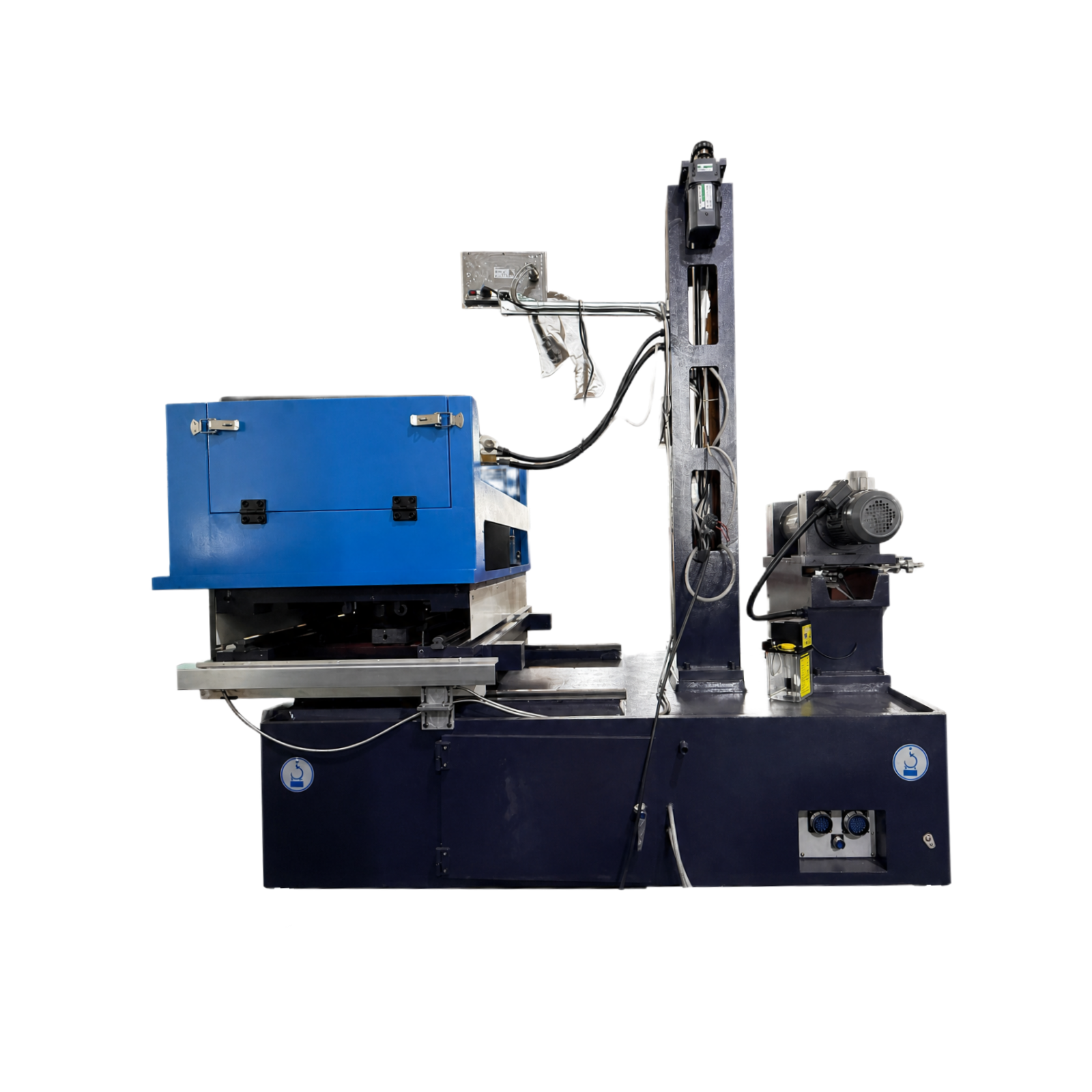
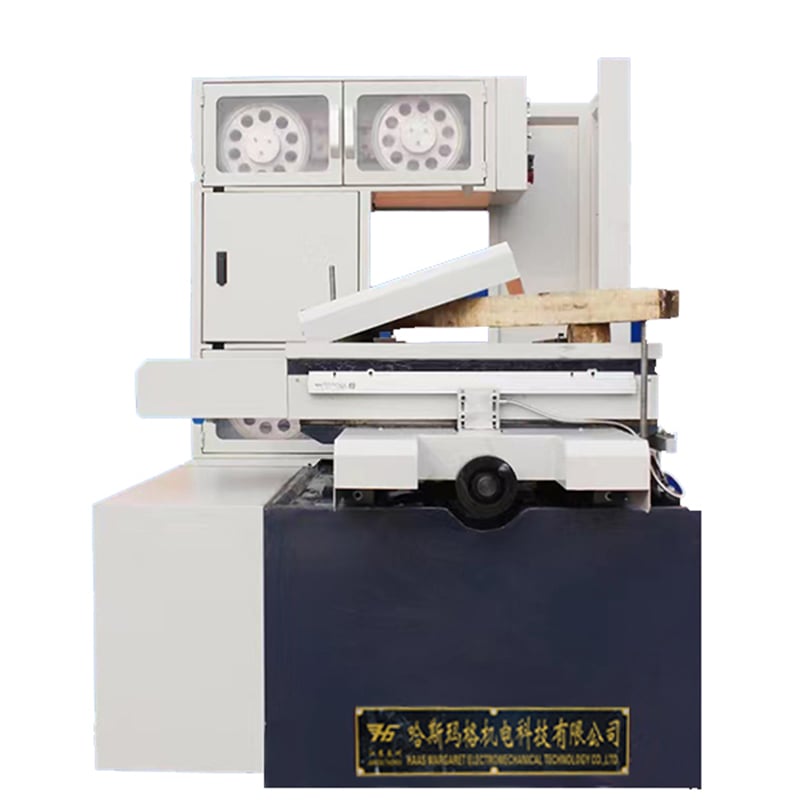
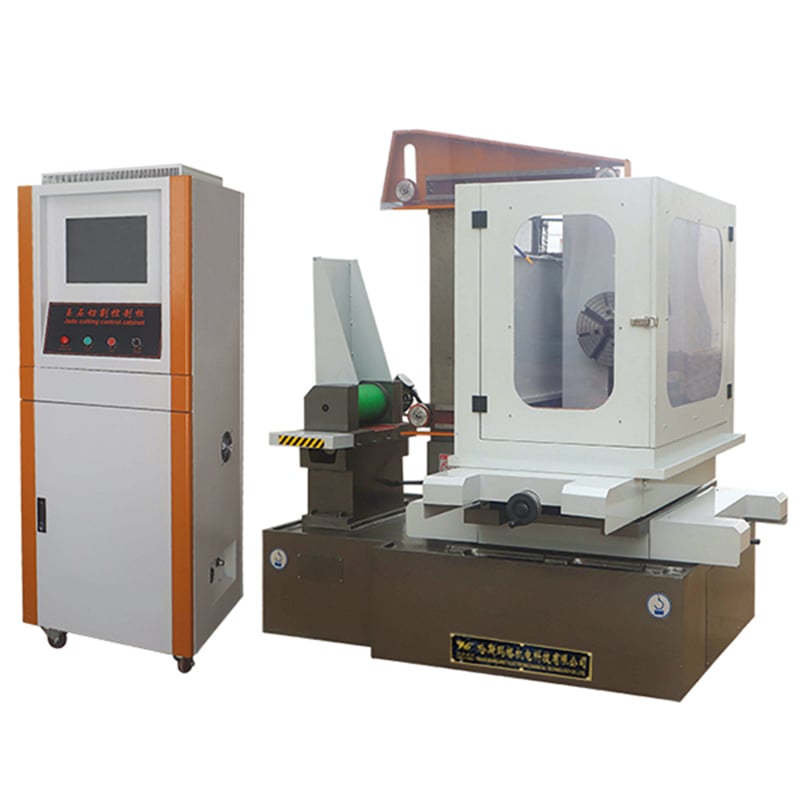
What is a Custom EDM Drilling Machine
EDM drilling machines typically use a rotating tubular electrode (brass, copper, or specialized electrode materials). During machining, a tiny discharge gap is maintained between the tool electrode and the workpiece. Pulse voltage causes local breakdown of the dielectric fluid, forming a discharge channel that generates instantaneous high temperature, melting and vaporizing the workpiece material which is then expelled. Continuous pulsed discharge action forms the desired hole.
Dielectric fluid is typically flushed into the machining zone through the interior of the electrode, serving cooling, chip removal, and dielectric recovery functions. The servo system adjusts electrode feed in real time based on voltage, current, and discharge status during machining, maintaining a stable discharge gap. Compared with conventional drilling, its core advantages include: virtually no conventional cutting force, making it suitable for thin-walled and small structural parts; minimal influence from material hardness—any conductive material can be machined; obvious advantages in micro deep holes, free from the rigidity and breakage limitations of micro drills; and significantly reduced mechanical burrs.
It should be noted that EDM may still produce a recast layer, heat-affected zone, and edge melting. Tool electrodes also experience electrical erosion wear, which must be controlled through electrode material selection, wear compensation, and automatic length measurement to ensure dimensional consistency.
Three Core Customization Capabilities
The core value of a custom EDM drilling machine lies in its ability to be configured according to the user’s actual machining requirements. The following analysis examines how customization capabilities expand the application boundaries of the equipment from three dimensions: auto wire feeding, 45° angle drilling, and custom stroke.
Auto Wire Feeding: The equipment is equipped with an automatic electrode feeding mechanism that enables automatic guiding, automatic insertion, and automatic re-threading after electrode breakage of the tubular electrode. In batch machining scenarios, the auto wire feeding function significantly reduces manual intervention time and improves the automation level of continuous machining. For occasional electrode breakage or short-circuit retraction during deep hole machining, auto wire feeding can quickly restore the machining state and reduce downtime losses. This function is especially suitable for multi-station, high-volume mold thread hole and injector micro-hole machining lines.
45° Angle Drilling (Angular Hole Machining): Through a multi-axis linkage structure (typically four-axis or five-axis configuration), the equipment can achieve multi-angle oblique drilling including ±45°, commonly referred to in the industry as “angle drilling.” Conventional vertical drilling machines can only perform vertical hole machining, while 45° angle drilling capability enables the equipment to handle complex conditions such as curved surface parts, inclined cooling holes, and oblique film cooling holes. In applications such as aerospace turbine blade film cooling holes and mold inclined cooling channels, 45° angle drilling combined with a rotary table can complete multi-angle hole machining in a single setup, avoiding positioning errors caused by multiple setups. Note that discharge gap and chip removal conditions differ for angular holes versus vertical holes, and flushing pressure and servo feed parameters should be adjusted accordingly.
Custom Stroke: The X, Y, and Z axis strokes of the machine can be non-standard customized according to the user’s workpiece size range, rather than being limited to the fixed stroke of standard models. For large mold plates, long shaft parts, or multi-station fixtures for batch setup, customizing larger X/Y axis strokes enables all hole positions to be machined in a single setup, reducing repositioning times and improving overall machining efficiency and hole position consistency. Z-axis stroke customization is suitable for deep hole machining or high-fixture conditions, ensuring sufficient vertical movement space for electrode feed. Custom stroke must be comprehensively matched with machine rigidity, servo accuracy, and table load capacity—it is not simply a matter of enlarging dimensions.
Technical Parameter Comparison: EDM Drilling vs. Conventional Drilling
The table below systematically compares EDM drilling machines and conventional mechanical drilling from dimensions such as machining method, machining force, material adaptability, and micro-hole performance, helping readers quickly identify the right equipment for their needs.
Comparison Dimension |
EDM Drilling Machine |
Conventional Mechanical Drilling |
Machining Method |
Pulsed discharge non-contact erosion |
Mechanical cutting contact machining |
Machining Force |
Virtually no conventional cutting force |
Axial force and torque present |
Material Adaptability |
Suitable for difficult-to-machine conductive materials |
Limited by material hardness and tool performance |
Micro-hole Performance |
Clear advantage for 0.1 mm-class micro holes |
High difficulty for small deep holes, prone to breakage |
Angular Hole Machining |
Multi-axis config enables 45° angle drilling |
Requires special fixtures, angle limited |
Thin-walled Parts |
Less prone to mechanical extrusion deformation |
Prone to deformation and burrs |
Automation Capability |
Auto wire feeding, auto electrode change available |
Manual tool change or tool magazine required |
Tool Wear |
Electrode wear present, compensable |
Drill wear present, requires periodic replacement |
In terms of pulse power supply, pulse width, peak current, pulse interval, and discharge frequency collectively affect machining efficiency, hole enlargement, electrode wear, and surface quality. Lower single-pulse energy is beneficial for finishing and reducing heat impact, while higher energy improves material removal rate. Parameters should be matched according to electrode diameter, material, hole depth, and machining stage. For dielectric fluid, deionized water is a common choice; resistivity should be controlled according to equipment requirements and the actual process window. For deep hole machining, flushing pressure, flow rate, and chip removal capability are often more critical than water quality indicators alone.
Typical Application Scenarios
Mold Industry: Primarily used for wire-cut thread holes, cooling holes, and other micro deep hole machining. The auto wire feeding function can greatly improve the efficiency of batch machining with multiple thread holes, while custom stroke adapts to single-setup machining of large mold plates. For thread holes, focus should be on hole position accuracy, repeat positioning accuracy, and hole axis deviation.
Aerospace: Can be used for film cooling holes in turbine blades and micro-hole machining of other high-temperature alloy parts. The 45° angle drilling capability combined with multi-axis linkage can complete curved surface angular hole machining in a single setup, avoiding multiple setup errors. Actual hole diameter and depth-to-diameter ratio should be determined based on specific part design.
Automotive Components: Can be applied to micro-hole machining such as fuel injectors and fuel systems. Some injectors involve hole diameters of 0.1 to 0.25 mm, and final quality requires comprehensive control of hole diameter, taper, hole shape, and flow characteristics. Auto wire feeding and custom stroke configurations can adapt to the automation needs of batch production lines.
Additionally, EDM drilling can be used in chemical fiber spinnerets, precision nozzles, medical metal parts, and cemented carbide parts. When selecting equipment, enterprises should not only look at “minimum hole diameter” or “maximum depth-to-diameter ratio,” but should verify actual hole diameter and position accuracy, hole axis deviation and taper, machining efficiency at target hole depth, electrode wear and compensation capability, deep hole flushing and chip removal capability, and batch machining consistency.
Conclusion
The core value of a custom EDM drilling machine is to provide an efficient non-contact machining solution for micro holes, deep holes, angular holes, and difficult-to-machine conductive material holes that conventional mechanical drilling struggles to solve. Auto wire feeding enhances the automation level of batch machining, 45° angle drilling expands the machining capability for angular and curved holes, and custom stroke ensures the equipment is precisely matched to workpiece size and production line layout.
However, EDM drilling is not a “wear-free, defect-free” universal process. Electrode wear, chip removal, abnormal discharge, hole taper, recast layer, and heat-affected zone remain important factors determining machining quality. Truly valuable customization is not simply adding axes or increasing power supply output, but building a complete process system around “material—electrode—discharge parameters—flushing—servo control—inspection—automation,” precisely matching equipment parameters with actual machining requirements to achieve simultaneous optimization of accuracy, efficiency, and overall cost in precision manufacturing.
 Hot News
2026-11-04
2026-10-28
2026-10-21
2026-09-16
2026-09-09
2026-09-02

 EN