EN




EDM Drilling: Process Control and Hole Acceptance
An EDM drilling machine forms holes by controlled electrical discharges between an electrode and a conductive workpiece. It does not use a conventional cutting edge. When comparing EDM drilling machines, distinguish the discharge process from the positioning system and from the accepted finished-hole result.
For high-precision work, start with the drawing: finished diameter and tolerance, depth, entry angle, position, taper or straightness, edge condition and surface-integrity limits. A machine feature, electrode catalogue size or positioning specification does not by itself establish that the finished hole will meet those requirements.
The Core Principles of EDM Drilling Technology
Electrical Discharge Fundamentals
In a common small-hole EDM arrangement, a tubular electrode advances toward the conductive workpiece while working fluid passes through the electrode. Electrode rotation is commonly used. Voltage pulses produce controlled discharges across a small gap; localized heating removes material without a conventional drilling edge contacting the workpiece.
The working fluid is part of the electrical and flushing process. It supports the discharge cycle and carries eroded particles away from the gap. Use the fluid, filtration and operating conditions specified for the particular machine and generator. Restricted flushing or accumulated debris can disturb machining; more pressure is not a universal solution for every hole geometry.
Precision Control Systems
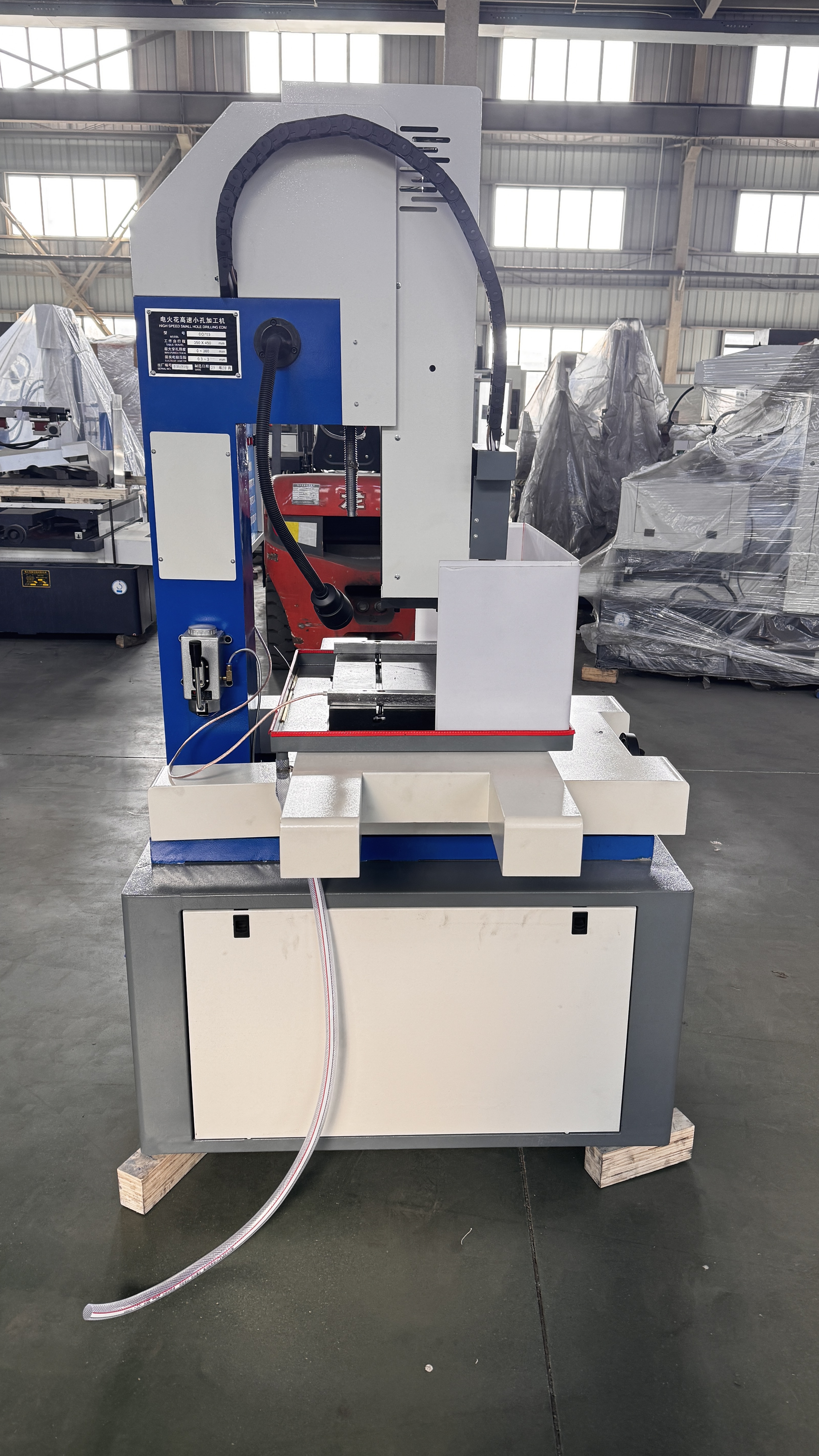
Servo feed responds to discharge-gap conditions to advance or retract the electrode as machining proceeds. This gap-control function is different from programmed coordinate positioning. A machine with controlled electrode feed is not necessarily equipped for CNC X/Y positioning, angular indexing or automatic electrode changes.
Hole size and form also depend on electrode wear and runout, guide condition and alignment, unsupported electrode length, material, depth, flushing and electrical conditions. A quoted tolerance needs a named configuration, representative workpiece, process condition and inspection method. This guide does not assign one universal finished-hole tolerance to all EDM drilling machines.
Advanced Features and Capabilities
Multi-Axis Positioning Systems
CNC coordinate positioning can support repeated hole patterns on appropriately equipped machines. Angular drilling may require a suitable fixture, indexing device or additional rotary or tilting axes. The available travel, clearance, guide access, controller functions and installed options must match the part; an axis count alone does not establish every angular capability.
Positioning accuracy, positioning repeatability and finished-hole tolerance are different specifications. Review what each value measures and the conditions under which it applies. Fixture and datum errors, electrode alignment, wear and the discharge process can affect the finished result even when the positioning system meets its stated specification.
Automated Operation Features
On suitably equipped systems, program storage, automatic electrode or guide handling and other options can support repeated operations. Check the exact supplied configuration and its operating sequence. These features are not established as standard on every EDM drilling machine, and a general article is not evidence that a particular quoted model includes them.
Wear compensation and process monitoring, where fitted, can help manage electrode consumption or identify abnormal machining conditions. They do not replace inspection of the finished hole. Ask for a demonstration with the proposed configuration, part geometry and acceptance plan rather than assuming that an automation feature guarantees an uninterrupted or conforming production run.
Applications in High-Precision Industries
Aerospace Component Manufacturing
EDM drilling is used for particular cooling-hole applications in electrically conductive turbine components. Applicability depends on the alloy, hole geometry, angle, depth, access and required surface condition. An aerospace application example does not establish that every EDM drilling configuration is suitable for that feature.
Avoid equating the absence of a conventional cutting edge with the absence of thermal effects. EDM is a thermal removal process; recast material and other surface-integrity effects may need evaluation where the part requirement calls for it. This article provides no aerospace approval, customer production case or qualification record for a HarsMarg machine.
Medical Device Production
A medical-device-related part should be evaluated against its actual drawing and material condition rather than its industry label. Critical machining requirements may include hole size, position, taper, edge condition and surface integrity, each with an agreed inspection method. Suitability must be established for the specific component and process.
This machining description establishes no antibacterial effect, biocompatibility, sterility or regulatory approval. A surface-roughness value alone is not evidence of those outcomes. The component and any downstream processes require their own applicable evaluation; an EDM machine's general capability is not a substitute for that evidence.
Maintenance and Optimization Practices
Regular Maintenance Procedures
Follow the supplied maintenance instructions for working-fluid condition, filtration, flushing paths, electrode guides, seals and other specified items. Inspect fixtures and alignment as required for the intended work. Maintenance intervals and replacement limits should come from the machine and component documentation, not a generic online schedule.
Keep records of checks, wear observations, replacements and any changes that could affect the setup. Recheck the relevant machining result after maintenance or a configuration change. Work on energized equipment or pressurized systems must follow the site's approved safety and isolation procedures and be performed by appropriately qualified personnel.
Performance Optimization Techniques
Use the machine and generator's approved technology guidance as the starting point for a representative trial. Record the material and condition, hole geometry, electrode and guide, fixture, fluid and flushing, electrical settings and feed behaviour. Do not copy one online parameter recipe across different machines, materials, diameters and depths.
Evaluate cycle time together with the agreed dimensional and surface results, electrode consumption and interruptions. Check enough representative holes to support the intended decision. A faster trial or one acceptable diameter reading does not establish repeatability, total production cost or conformity of every feature.
Frequently Asked Questions
What materials can be processed using an EDM drilling machine?
Standard EDM requires an electrically conductive workpiece. Steels, titanium alloys, conductive carbides and other conductive materials may be candidates, but grade, condition, coatings, geometry and acceptance requirements still matter. Freedom from a conventional cutting edge does not make every conductive material or every hole equally feasible; confirm the actual combination.
How does EDM drilling compare to conventional drilling methods?
Conventional drilling removes material with a cutting edge; EDM drilling uses controlled discharges and requires a conductive workpiece. EDM can be useful where hardness, access or a particular hole geometry makes mechanical drilling difficult. Compare the complete setup, cycle, consumables, surface condition and inspection needs; neither process is universally faster, more accurate or better for every part.
What determines the accuracy of EDM-drilled holes?
Finished-hole accuracy depends on the machine and setup, datums and fixture, electrode and guide, alignment and runout, wear, material and depth, fluid and flushing, electrical conditions and measurement method. State which size, position, form or direction characteristic must pass. Agree a representative trial and inspection rule instead of treating a generic precision number as a model-wide guarantee.