EN



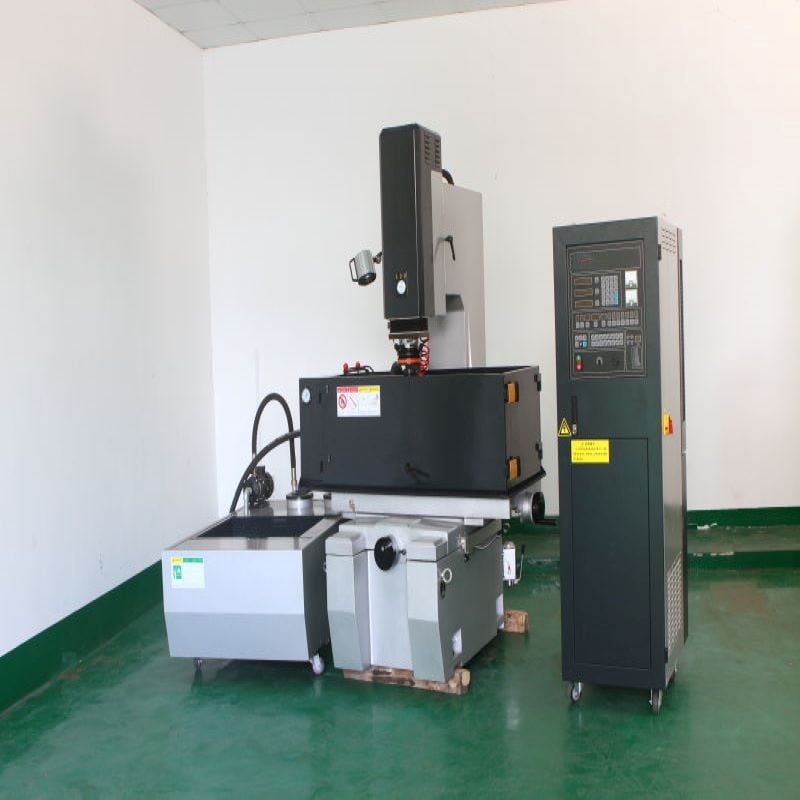
Wire EDM can be worth evaluating when a conductive part needs a detailed through-profile, particularly after hardening or where conventional cutting loads make a delicate feature difficult to machine. It is not a universal replacement for milling or sawing. The useful comparison is whether each process can meet the complete drawing with an acceptable setup, cycle time, surface condition and inspection plan.
Wire Electrical Discharge Machining (EDM) uses a travelling wire electrode and electrical discharges to remove material from a conductive workpiece.
Here, “traditional cutting” means processes that remove material with a cutting edge, such as milling and sawing. Die-sinking EDM is a different comparison: it uses a shaped electrode rather than a travelling wire. See our sinker EDM and wire EDM comparison when the requirement is a blind cavity or shaped recess.
When Wire EDM Is Worth Evaluating
A hardened conductive part with a detailed through-contour is a useful starting case. Wire EDM does not depend on a rotating cutting edge to follow that profile. This can be helpful for punches, die profiles, narrow slots and other features that are difficult to approach with a conventional tool.
Lower conventional cutting load can also help with slender or delicate features, but it does not remove the need for workholding and process control. The fixture must support the part throughout the cut, including when a slug separates. Material condition, released residual stress, wire behaviour and flushing still need attention.
Wire access is essential. An open contour may start from an edge; a closed internal contour normally needs a prepared start hole and a route for the wire through the workpiece. Confirm guide and fixture clearance, not just the overall part dimensions. A small internal radius also has a practical limit: a fine wire does not make an infinitely sharp corner.
For the wider process benefits and limitations, read the Wire EDM advantages guide.
When Milling or Sawing May Be the Better Starting Point
Sawing may be the more direct option for a simple open separation when the resulting stock allowance can be finished later. Milling may be preferable where the drawing requires pockets, accessible surfaces or substantial bulk removal. These are screening choices, not a claim that either process is always faster or cheaper.
Compare the complete route. A quick rough cut that leaves several later operations is not automatically the lowest-cost route. Conversely, a detailed Wire EDM profile may not justify its setup and cutting time when the drawing can be satisfied by a simpler operation.
| Drawing requirement | Process to evaluate first | What must still be confirmed |
|---|---|---|
| Detailed through-profile in hardened conductive material | Wire EDM | Start access, thickness, internal radius, tolerance, finish and surface integrity |
| Simple open separation with later finishing | Sawing and the complete finishing route | Stock allowance, workholding, burr control and downstream operations |
| Accessible pocket, face or substantial bulk removal | Milling | Tool access, material condition, fixture, cutting load and inspection |
| Blind cavity or shaped recess | Milling or die-sinking EDM | Cavity access, electrode or tool requirements, surface condition and complete cycle |
Compare Quality Without Borrowing Catalogue Limits
Do not apply one tolerance or Ra value to every Wire EDM machine and every part. Ask which model, material grade, thickness, geometry, cut sequence and measurement method produced the stated result. Define where dimensions and roughness will be measured, and which acceptance rule applies.
Wire EDM is an electrical-discharge process. The surface can require assessment for thermal effects, including recast material or a heat-affected zone. A finish requirement alone does not replace a surface-integrity requirement. Where the drawing makes either critical, agree a representative sample-cut and inspection plan before relying on a catalogue figure.
Primary technical reference: Makino: Advanced EDM Processes for Aerospace, for background on EDM surface integrity. This reference does not establish HarsMarg performance or guarantee elimination of a heat-affected zone.
Compare Complete Time and Operating Requirements
Include preparation, fixturing, any start-hole work, the complete production cut, every required trimming pass, inspection and later finishing. Also compare consumables, working-fluid care, filtration, wire and guide condition, maintenance and operator checks.
Do not assume automatic threading, multi-part automation or extended unattended operation from the words “CNC” or “Wire EDM”. Confirm those functions for the selected configuration and job. Likewise, lower power consumption or lower labour cost must be supported by a defined operating comparison, not inferred from the absence of a rotating tool.
Information to Provide for a Useful Comparison
Send the drawing and identify:
- Material grade, hardness, heat-treatment condition and any coating.
- Overall dimensions, cutting thickness, weight and fixture allowance.
- Required profile, internal radius, taper, entry route and start-hole access.
- Dimensional tolerance, surface roughness and any surface-integrity acceptance rule.
- Quantity, proposed process route, cycle-time requirement and inspection method.
- Destination country, local power supply and any required controller or automation functions.
These details allow the comparison to focus on the actual part rather than on general claims about precision or speed.
Frequently Asked Questions
Is Wire EDM Always More Accurate Than Milling?
No universal comparison is appropriate. Compare the specific geometry, material, setup, machine configuration and inspection requirement. A qualified process that meets the drawing is more useful than an unrelated best-case tolerance.
Does a Fine Finish Mean No Further Work Is Needed?
Not necessarily. The drawing may also require an edge condition, surface-integrity check or later finishing. Confirm those requirements separately from a roughness value.
Is a CNC Wire EDM Machine Automatically Unattended?
No. CNC path control does not establish automatic threading, slug handling, recovery from interruption or a safe unattended workflow. These need configuration and application-specific confirmation.
Request a Process Review
Send the drawing, material, thickness, quality requirements, quantity and proposed process route. Ask which machine configuration and cut plan should be evaluated, what remains to be confirmed, and whether a representative sample and inspection record are needed. Contact HarsMarg for a technical review.